

In today’s highly competitive digital landscape, simply launching a mobile app is not enough. Businesses must ensure their app includes the right features to stand out, attract users, and drive long-term engagement. Choosing the right features is what separates a successful app from one that gets lost in the crowded app marketplace.
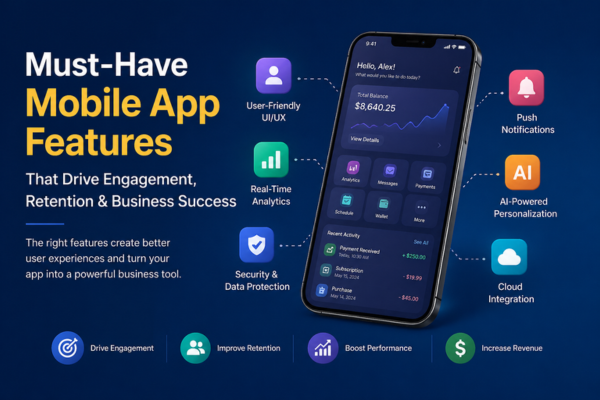
The success of a mobile app depends heavily on how well it meets user expectations, solves real problems, and delivers a seamless experience. From intuitive design to advanced functionalities like AI-driven personalization, every feature plays a critical role in shaping user perception and business outcomes.
In this blog, we will explore how the right features can make your mobile app successful, the must-have functionalities for modern apps, and how businesses can strategically choose features to maximize ROI. Want to integrate AI-driven solutions into your business? Get started with your project today and explore tailored digital transformation solutions here.
Why Features Matter in Mobile App Success
Features are the backbone of any mobile application. They define what your app does, how users interact with it, and why users should keep coming back.
A well-designed feature set:
- Enhances user experience
- Improves engagement and retention
- Drives conversions and revenue
- Builds brand credibility
On the other hand, apps with poor or unnecessary features often suffer from low downloads, high uninstall rates, and negative reviews.
A strong example of how the right features can make a mobile app successful is The Law Spot case study. This platform was designed to solve a real-world problem, connecting clients with the most relevant lawyers based on their needs and location. By focusing on essential features like user-friendly UI/UX, cross-platform accessibility (web, Android, and iOS), and seamless communication, the app created a smooth and efficient user experience.
The development team prioritized features that truly mattered, such as intuitive navigation, reliable performance, and smart matching between clients and legal professionals. As a result, the platform successfully bridged the gap between lawyers and clients, making legal services more accessible and efficient.
This case highlights an important lesson: instead of overloading an app with unnecessary features, focusing on core functionalities that solve user problems leads to higher engagement, better retention, and overall app success.
Understanding User Needs Before Choosing Features
Before diving into development, it’s essential to understand your target audience. Successful mobile apps are built around user needs, not assumptions.
Key Steps:
- Conduct user research
- Analyze competitor apps
- Identify pain points
- Define user journeys
When businesses align features with user expectations, they create apps that feel intuitive and valuable.
Essential Features That Make a Mobile App Successful
1. User-Friendly UI/UX Design
A clean, intuitive interface is one of the most important features of a successful mobile app. Users should be able to navigate your app effortlessly.
Why it matters:
- Reduces bounce rate
- Improves user satisfaction
- Increases session duration
A cluttered or confusing interface can drive users away within seconds.
2. Fast Performance and Speed Optimization
Speed is critical. Even a one-second delay can significantly impact user engagement.
Key elements:
- Quick loading times
- Smooth transitions
- Minimal lag
Optimizing performance ensures users stay engaged and don’t abandon the app.
3. Personalization and AI Integration
Modern users expect personalized experiences. AI-powered features allow apps to deliver tailored content and recommendations.
Examples:
- Personalized product suggestions
- Smart notifications
- Behavior-based content
Personalization enhances user engagement and builds stronger connections with users.
4. Push Notifications
Push notifications are a powerful tool to keep users engaged.
Benefits:
- Re-engage inactive users
- Promote offers and updates
- Increase retention rates
However, overusing notifications can annoy users, so they must be used strategically.
5. Strong Security Features
Security is a top priority for users, especially when dealing with sensitive data.
Essential security features:
- Data encryption
- Secure authentication (OTP, biometrics)
- Compliance with data protection standards
A secure app builds trust and protects your brand reputation.
6. Offline Functionality
Not all users have constant internet access. Offline functionality ensures your app remains usable even without connectivity.
Examples:
- Saving data locally
- Offline browsing
- Limited feature access
This feature improves user experience and accessibility.
7. Seamless Integration with APIs
APIs allow apps to connect with third-party services and expand functionality.
Common integrations:
- Payment gateways
- Social media logins
- Maps and location services
API integration enhances app capabilities without building everything from scratch.
8. Cross-Platform Compatibility
A successful app should work seamlessly across multiple platforms, including iOS and Android.
Advantages:
- Wider audience reach
- Consistent user experience
- Reduced development costs
Cross-platform compatibility ensures your app is accessible to a broader user base.
9. Scalable Architecture
As your business grows, your app should be able to handle increased traffic and data.
Scalability features include:
- Cloud integration
- Modular architecture
- Load balancing
A scalable app prevents performance issues and supports future growth.
10. Real-Time Features
Real-time functionality enhances interactivity and user engagement.
Examples:
- Live chat
- Real-time tracking
- Instant updates
These features create a dynamic user experience and improve satisfaction.
Another strong example of how the right features can make a mobile app successful is Stable Hub Case Study. This platform was developed to solve a critical communication gap between horse trainers and owners by enabling real-time updates, activity tracking, and seamless interaction regardless of location. The app was built with a user-centric approach, offering both web and mobile accessibility, ensuring convenience for all users.
Key features such as instant communication, personalized updates, and easy activity management allowed trainers to efficiently share information while keeping owners consistently informed. The use of modern technologies like Flutter and MERN stack ensured smooth performance across platforms, reinforcing reliability and scalability.

How the Right Features Improve User Engagement
User engagement is directly linked to the features your mobile app offers. Features that provide value, convenience, and personalization encourage users to return consistently. Key engagement drivers include interactive design, personalized content, quick response time, and relevant notifications. Apps focusing on user engagement typically achieve higher retention rates, stronger loyalty, and better reviews. This ultimately improves business growth, increases conversions, and strengthens overall app performance in competitive markets. Businesses that strategically prioritize these features create seamless experiences that keep users engaged and satisfied over time. Ultimately engagement-focused design leads to improved retention, revenue growth, and long-term app success overall performance.
The Role of Features in Increasing ROI
The right features not only enhance user experience but also play a crucial role in driving business growth and profitability. When mobile apps are built with revenue-focused functionalities, they open multiple monetization opportunities that directly impact ROI. Key revenue-boosting features include in-app purchases, which allow users to buy premium content or items, subscription models that generate recurring income, secure payment gateway integration for seamless transactions, and ad monetization strategies for additional revenue streams. By strategically implementing these features, businesses can effectively increase conversions, improve customer lifetime value, and maximize their return on investment in a highly competitive digital marketplace.
Avoiding Feature Overload
Avoiding feature overload is one of the most important principles in successful mobile app development. Many businesses make the mistake of assuming that adding more features automatically improves their app, but in reality, it often leads to the opposite effect. When an app is overloaded with unnecessary functionalities, it becomes confusing for users, making navigation difficult and reducing overall usability. Another major issue is performance degradation. Too many features can slow down the app, increase loading times, and negatively impact the user experience. This often results in higher uninstall rates and lower user retention. Additionally, feature overload significantly increases development and maintenance costs, making the app more expensive to build and scale.
Instead of overloading the app, businesses should adopt a Minimum Viable Product (MVP) approach. This means launching the app with only the essential features required to solve core user problems. Once the app is live, businesses can collect user feedback, analyze behavior, and gradually introduce new features based on actual demand rather than assumptions. This approach not only ensures better performance and usability but also helps in building a more focused and scalable product. Ultimately, prioritizing quality over quantity leads to higher user satisfaction, improved engagement, and long-term app success in a competitive market.
A strong example of how well-planned features improve digital products can be seen in the Buzznog case study. The platform was designed to enhance fan engagement by using data-driven personalization, real-time insights, and scalable architecture to deliver meaningful experiences. By focusing on targeted engagement rather than generic interactions, Buzznog enabled brands and artists to connect more effectively with their audiences. This approach highlights how the right feature set—such as analytics, personalization, and seamless integration can significantly improve user engagement and business outcomes. It proves that feature-driven development is essential for building successful, scalable digital platforms.
Choosing the Right Features for Your Mobile App
Choosing the right features for your mobile app requires a clear and strategic approach to ensure long-term success. The first step is to define your business goals so every feature aligns with your overall vision. Next, it is important to deeply understand your target users, their needs, and pain points. Businesses should then prioritize core features that solve the main problem effectively rather than adding unnecessary complexity. Launching a Minimum Viable Product (MVP) helps validate ideas quickly and cost-effectively. After launch, gathering user feedback is essential to refine the product. Continuous improvement ensures the app evolves with user expectations and market trends.
Future Trends in Mobile App Features
Future trends in mobile app features are rapidly shaping the way businesses build and deliver digital experiences. As technology evolves, apps are becoming more intelligent, personalized, and user-centric. Key emerging trends include AI and machine learning integration for smarter automation and personalization, voice search capabilities for hands-free interaction, and augmented reality (AR) features for immersive experiences. IoT-enabled applications are connecting devices for seamless control, while blockchain is enhancing security and transparency in transactions. Staying updated with these innovations allows businesses to remain competitive, improve user satisfaction, and deliver future-ready mobile applications that meet evolving market and user expectations effectively.
How Feature Optimization Impacts App Store Rankings
Feature optimization plays a crucial role in improving app store rankings, as algorithms prioritize apps that deliver strong user experiences. App performance and speed are key factors, since faster apps lead to better usability and lower bounce rates. High user retention rates also signal that the app provides ongoing value, which positively impacts ranking. Additionally, positive user feedback and reviews build trust and improve visibility in search results. Regular updates that refine and enhance features further demonstrate active development and reliability. Overall, apps with well-optimized features are more likely to rank higher, gain visibility, and achieve long-term success in competitive app stores.

Common Mistakes to Avoid
Common mistakes in mobile app feature selection can significantly reduce an app’s success, even when the idea is strong. One major mistake is ignoring user feedback, which results in features that do not match real user needs and expectations. Another common issue is overcomplicating the app by adding too many unnecessary features, which confuses users and makes navigation difficult. Poor performance optimization is also a critical problem, as slow loading times and laggy interfaces lead to higher uninstall rates. Additionally, neglecting security can expose user data to risks and damage brand trust. Skipping proper testing further increases the chances of bugs and crashes after launch. According to industry best practices, focusing on user-centered design, MVP development, and continuous improvement can significantly increase an app’s chances of success in the competitive market. As highlighted in the complete guide to mobile app development for businesses, successful apps require a well-structured approach that prioritizes core features, usability, and scalability from the very beginning. By avoiding these pitfalls and following a structured development process, businesses can build more efficient, user-friendly, and secure applications that perform better in the market and achieve long-term success.
Conclusion
The success of a mobile app is not determined by the number of features it includes, but by how effectively those features serve both users and business objectives. A well-designed app focuses on solving real problems rather than overwhelming users with unnecessary complexity. By carefully selecting the right features, businesses can build applications that are engaging, efficient, and highly profitable. Core elements such as intuitive UI/UX design ensure smooth navigation and a seamless experience, while advanced functionalities like AI-powered personalization and real-time updates significantly enhance user engagement. Every feature should have a clear purpose, whether it improves usability, increases retention, or drives revenue.
When these features are combined with a strategic development approach, the impact becomes even stronger. Continuous optimization, regular updates, and user feedback integration help refine the app over time, ensuring it stays relevant in a competitive market. This approach transforms a simple mobile application into a powerful business tool that supports growth and long-term success. If businesses want their mobile app to succeed, they must start by deeply understanding their target users, prioritizing essential features, and building with scalability, performance, and future expansion in mind.