
AI Development is reshaping how modern businesses operate, scale, and compete in digital markets. Companies today are not only using AI for innovation but also for automation, decision-making, and improving customer experiences. With the right AI Development strategy, organizations can reduce manual work, increase efficiency, and unlock new revenue streams.
For mobile app development companies, AI Development is no longer optional. It is a core part of building intelligent, scalable, and future-ready applications. From predictive analytics to AI-powered chat systems, businesses are using AI to transform operations across industries.
This blog explains a complete roadmap for AI Development in business environments. It covers strategy, tools, implementation steps, and real-world applications. You will also learn how AI supports automation, improves decision-making, and drives digital transformation.
The goal is simple: help businesses understand how AI Development can be used to build smarter systems and achieve long-term growth. Ready to transform your business with smart automation and scalable solutions? Explore how expert AI Development can accelerate your digital growth today. Get started here.
1. Understanding AI Development in Business Growth
AI Development refers to building intelligent systems that can analyze data, learn patterns, and make decisions with minimal human input.
In business growth, it helps in:
- Automating repetitive tasks
- Improving customer support systems
- Enhancing data-driven decision-making
- Reducing operational costs
Key areas where AI Development is applied:
- Customer behavior prediction
- Sales forecasting
- Marketing automation
- Process optimization
Businesses use AI Development to stay competitive and responsive in fast-changing markets. It creates a strong foundation for digital transformation and long-term scalability.
2. Key Benefits of AI Development for Enterprises
AI Development delivers measurable business value across industries by improving efficiency, reducing operational costs, and enabling smarter decision-making. It allows businesses to automate repetitive tasks, optimize workflows, and focus more on strategic growth rather than manual processes.
With AI-powered systems, companies can analyze large volumes of data in real time, identify trends, and predict customer behavior more accurately. This leads to better planning, stronger marketing strategies, and improved customer experiences.
Business Value:
- Faster decision-making
- Reduced human errors
- Improved customer experience
- Higher operational efficiency
- Scalable automation systems
Companies adopting AI Development often experience:
- Increased productivity
- Better resource management
- Stronger customer retention
AI also helps businesses understand market trends and user behavior more accurately. This leads to smarter strategies and improved ROI.
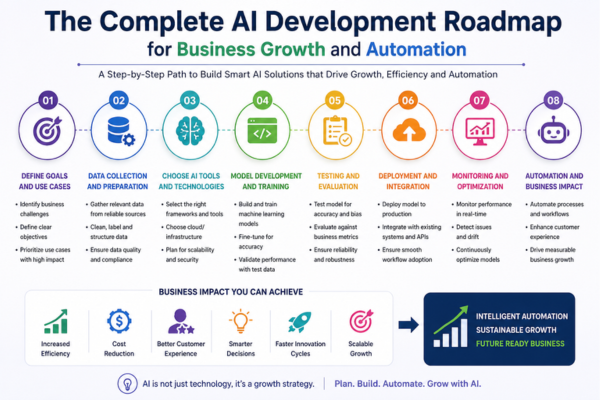
3. Complete AI Development Roadmap Overview
A structured roadmap is essential for successful AI Development implementation, as it ensures clarity, direction, and measurable progress throughout the project lifecycle. Without a proper plan, AI initiatives can become unorganized, costly, and difficult to scale effectively.
A well-defined roadmap helps businesses break down complex AI goals into manageable steps, from identifying problems to deploying final solutions. It also aligns technical development with business objectives, ensuring that every stage delivers real value.
Key elements of a strong AI roadmap include planning, data preparation, model development, testing, deployment, and continuous monitoring. This structured approach reduces risks, improves efficiency, and increases the chances of long-term success in AI Development projects.
Phases of AI Development:
- Problem identification
- Data collection
- Model selection
- Development & training
- Testing and validation
- Deployment and monitoring
Each stage ensures that AI systems are reliable and business-ready.
Key Focus Areas:
- Clear business goals
- Scalable architecture
- Continuous improvement
Without a roadmap, AI Development projects may fail due to poor planning or data issues.
4. Data Strategy and Preparation for AI Systems
Data is the foundation of AI Development. Without quality data, AI systems cannot perform effectively or deliver accurate results. The success of any AI model depends on how well the data is collected, processed, and structured. Clean, relevant, and well-labeled data helps AI systems learn patterns correctly and make reliable predictions.
Poor data quality can lead to biased outcomes, errors, and weak performance. That is why businesses must focus on strong data governance, proper storage, and continuous data improvement. In AI Development, better data always leads to smarter, faster, and more dependable intelligent systems that support business growth.
Steps in data preparation:
- Data collection from multiple sources
- Data cleaning and filtering
- Structuring and labeling
- Data storage and security
Importance of data quality:
- Improves model accuracy
- Reduces bias
- Enhances prediction reliability
Businesses investing in AI Development must prioritize strong data governance to ensure successful outcomes.
5. Choosing the Right AI Models and Tools
Selecting the right tools is a critical step in AI Development, as it directly impacts performance, scalability, and long-term success of AI solutions. The choice of tools determines how efficiently models are built, trained, and deployed within a business environment. Companies must evaluate tools based on their project requirements, budget, and technical capabilities.
Modern AI Development relies on a mix of frameworks, platforms, and cloud services that simplify complex processes. Popular frameworks like TensorFlow and PyTorch help in building machine learning models, while cloud platforms such as AWS, Google Cloud, and Azure provide scalable infrastructure for deployment.
Popular AI model types:
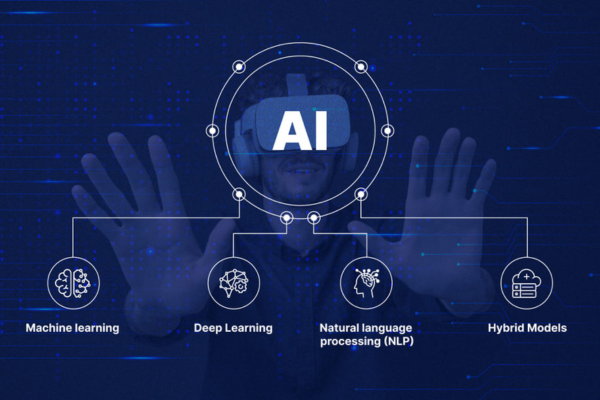
- Machine learning models
- Deep learning models
- Natural language processing models
Key tools used:
- Python frameworks
- TensorFlow
- PyTorch
- Cloud AI platforms
Factors to consider:
- Business requirements
- Scalability
- Cost efficiency
- Integration capability
The right combination of tools ensures faster and more effective AI Development outcomes.
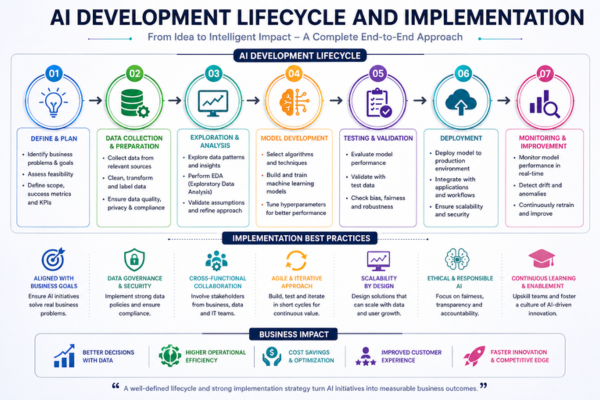
6. AI Development Lifecycle and Implementation
The AI Development lifecycle ensures structured execution.
| Stage | Description |
| Planning | Define business goals |
| Data Preparation | Collect and clean data |
| Model Building | Train AI models |
| Testing | Validate performance |
| Deployment | Launch AI system |
| Monitoring | Track and improve |
Key advantages:
- Structured workflow
- Better performance tracking
- Reduced project risks
AI Development lifecycle management ensures long-term success and system reliability.
7. AI Integration in Mobile and Web Applications
Modern mobile and web applications rely heavily on AI Development to deliver faster, smarter, and more personalized user experiences. Businesses are no longer building static apps; instead, they are creating intelligent platforms that learn from user behavior and adapt in real time. This shift is improving engagement, retention, and overall app performance across industries.
A strong example of this transformation can be seen in our work on the HereApp case study, where AI-driven systems and smart automation were used to enhance user experience and streamline operations. By integrating AI Development into mobile applications, businesses are now able to build scalable, data-driven solutions that continuously improve with usage, making apps more efficient and user-focused over time.
AI-powered features are now a core part of app ecosystems. They help applications understand user intent, predict needs, and automate interactions without requiring manual input. This makes apps more intuitive and user-friendly.
Key AI use cases in apps:
- Personalized content recommendations
- Smart search and auto-suggestions
- AI chatbots for instant support
- Voice recognition and assistants
- Image and text recognition features
- Behavior-based notifications
Benefits of AI integration:
- Improved user experience and satisfaction
- Higher engagement and retention rates
- Faster response times in applications
- More accurate personalization
- Better conversion rates for businesses
With AI Development, mobile and web apps become more than just tools—they evolve into intelligent systems that continuously improve based on user data and interactions. This creates long-term value for both users and businesses.
8. Automation and AI Agents in Business Processes
Automation is one of the strongest outcomes of AI Development, helping businesses reduce manual effort and improve operational speed. By integrating AI-powered systems, organizations can streamline repetitive tasks and allow teams to focus on higher-value work such as strategy and innovation.
AI agents play a major role in modern business processes. These intelligent systems can perform tasks independently, learn from data, and adapt to changing conditions without constant human supervision. This makes operations more efficient and less error-prone.
Common areas where automation and AI agents are widely used include:
- Customer support through AI chatbots
- Automated email responses and marketing campaigns
- Data entry and document processing
- Workflow approvals and task management
- Predictive maintenance in technical systems
With AI Development, businesses can build self-operating workflows that run 24/7. This not only improves productivity but also reduces costs and enhances customer satisfaction through faster and more reliable service delivery.
Use cases of automation:
- Customer support automation
- Email marketing workflows
- Invoice processing
- HR onboarding systems
AI agents can:
- Make decisions independently
- Learn from user interactions
- Execute tasks without human input
This leads to faster operations and reduced workload for employees. AI Development plays a major role in enabling these intelligent systems.
9. Challenges in AI Development Implementation
Despite its strong benefits, AI Development also comes with several practical challenges that businesses must plan for carefully. One of the biggest issues is data quality. AI systems depend on clean, structured, and relevant data, and poor data can lead to inaccurate results and weak performance.
Another major challenge is the high initial cost of AI Development, especially for advanced systems that require skilled professionals, infrastructure, and tools. Many organizations also struggle with a shortage of experienced AI talent, which slows down implementation and scaling.
Integration with existing systems is another common difficulty, as legacy software may not easily support modern AI solutions. Along with this, data privacy and security concerns are critical, especially when handling sensitive customer information.
To overcome these challenges, businesses should adopt a phased approach, invest in training, and use scalable cloud-based AI Development solutions for smoother adoption and long-term success.
Common challenges:
- Data privacy concerns
- High implementation costs
- Lack of skilled professionals
- Integration complexity
Solutions:
- Strong data governance policies
- Cloud-based AI tools
- Training and upskilling teams
- Phased implementation approach
Businesses must carefully plan AI Development to avoid these obstacles and ensure smooth execution.
10. Future Trends in AI Development
The future of AI Development is highly promising and evolving rapidly as businesses move toward smarter, data-driven ecosystems. One major trend is the rise of generative AI, which enables systems to create content, code, and solutions with minimal human input. Another key shift is toward autonomous AI agents that can perform complex tasks, make decisions, and optimize workflows without constant supervision. Edge AI is also gaining importance, allowing faster processing directly on devices instead of relying only on cloud systems.
Additionally, AI Development is becoming more focused on hyper-personalization, where apps and platforms adapt in real time to user behavior and preferences. Low-code and no-code AI tools are also making development more accessible to businesses of all sizes. As these trends grow, AI Development will continue to reshape industries by improving efficiency, reducing costs, and enabling fully intelligent digital transformation at scale. A practical example of this can be seen in the Buzznog case study, where AI-driven solutions were used to enhance user engagement and create more adaptive digital experiences.
Emerging trends:
- Generative AI systems
- AI-powered automation platforms
- Edge AI computing
- Hyper-personalized applications
Business impact:
- Faster innovation cycles
- Smarter business decisions
- Fully automated workflows
AI Development will continue to shape digital transformation across all industries, making businesses more intelligent and efficient.
Conclusion
AI Development is no longer a future concept; it is a present-day necessity for businesses aiming for sustainable growth and automation. From intelligent data processing to real-time decision-making systems, AI Development enables organizations to build scalable, adaptive, and highly efficient digital ecosystems that support long-term success. Companies that adopt AI Development early gain a strong competitive edge through automation, improved accuracy, and faster innovation cycles. It helps streamline operations, reduce operational costs, and enhance customer experiences across all digital touchpoints. As industries continue to evolve, AI Development will remain a key driver of digital transformation. It will empower businesses to create smarter workflows, unlock predictive insights, and build next-generation applications that continuously learn and improve. In the coming years, organizations that embrace AI Development strategically will lead the market with stronger resilience, agility, and innovation.
FAQs
1. What is AI Development in simple terms?
AI Development is the process of creating systems that can think, learn, and make decisions like humans. It helps automate tasks and improve business efficiency.
2. How does AI Development help businesses grow?
It improves productivity, reduces manual work, and enhances decision-making. Businesses can scale faster using automated and intelligent systems.
3. Is AI Development expensive for small businesses?
Costs depend on project size, but cloud-based solutions make AI Development more affordable. Small businesses can start with basic automation.
4. What industries benefit most from AI Development?
Industries like healthcare, e-commerce, finance, and mobile app development benefit greatly from AI-driven automation and analytics.
5. Can AI Development replace human workers?
AI supports humans by automating repetitive tasks, but it does not fully replace them. It enhances efficiency and productivity instead.