AI Automation vs. Traditional Automation is one of the biggest topics in business right now. Every business owner wants to save time, spend less money, and grow faster. Automation helps you do all of that. But today, you have two choices. You can use the old way or the smart new way. Traditional automation follows set rules. It does the same thing every time. AI automation is different. It thinks, learns, and gets better over time. Both options work well. But which one is right for you? This blog will explain everything in simple words. You will learn what makes them different, what they cost, and which one fits your business best. Whether you run a small shop or a big company, this guide is for you. Want to get started today? Visit this link to start your project and let our team help you right away.
What Is Automation in Business?
Let us start with the basics.
Automation means using technology to do tasks on its own. You do not have to do everything by hand. The system does the work for you.
This saves time. It saves money. It helps your business run better.
There are two main types of automation:
- Traditional Automation — follows fixed rules that you set
- AI Automation — uses smart technology to think and learn
Both types help with business process automation. But they work in very different ways.
📌 What Is AI Automation vs Traditional Automation?
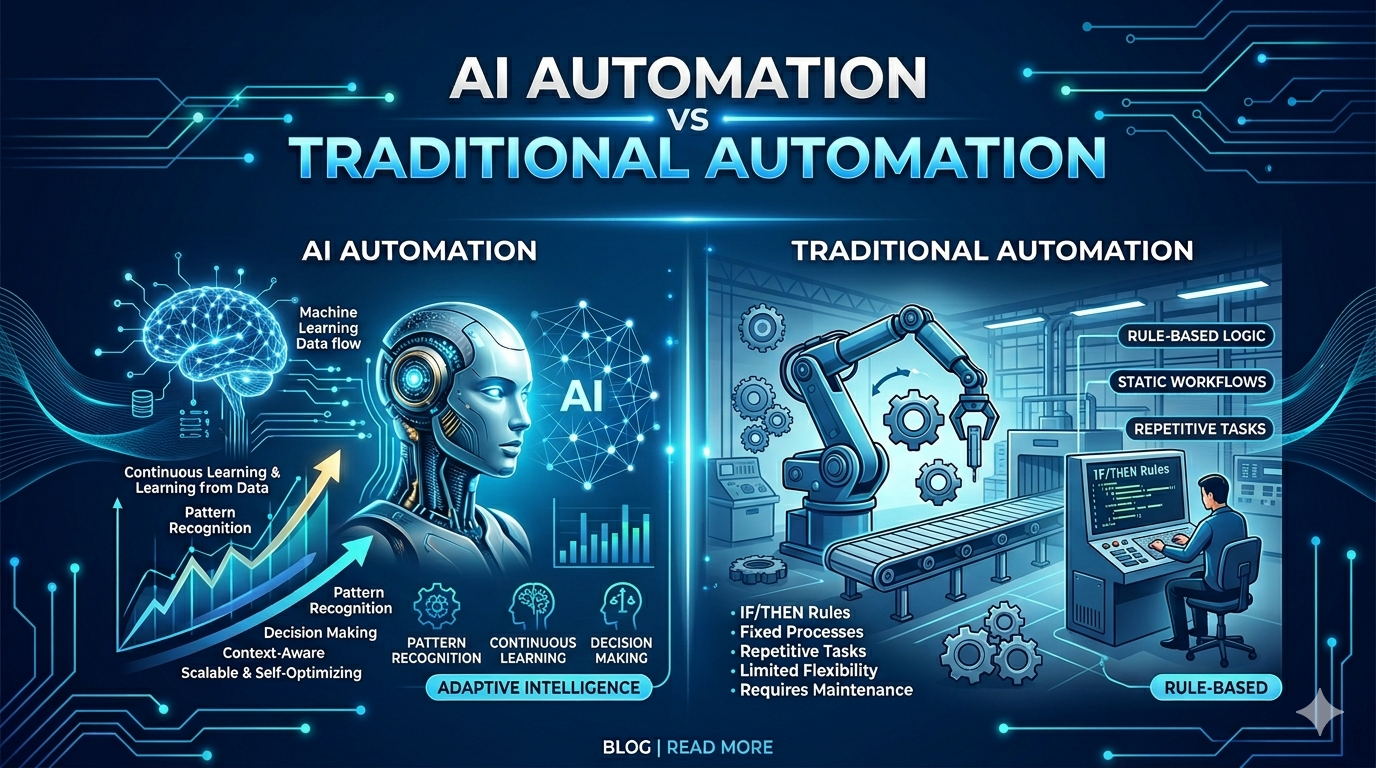
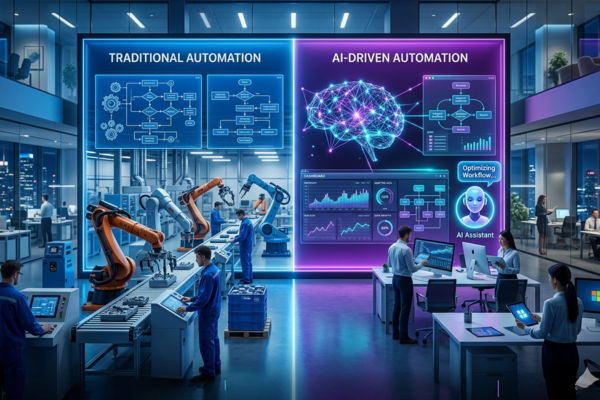
Traditional automation runs tasks using fixed rules. It always does the same thing. AI automation uses artificial intelligence to learn from data. It can handle new situations, make smart choices, and get better over time. The big difference is that AI automation thinks. Traditional automation just follows orders.
Why AI Automation Matters for Modern Businesses
Business moves fast today. Things change all the time. Customers want fast answers. Data grows every day. Old systems cannot always keep up.
That is where AI workflow automation helps.
Here is why more businesses are switching to AI automation:
- It handles hard decisions that simple rules cannot deal with
- It learns from past data and keeps getting smarter
- It cuts down on mistakes that humans often make
- It works all day and all night without stopping
- It grows with your business without needing a full rebuild
- It connects with your other tools like your CRM, email, or sales system
Businesses that use AI-powered automation tools are getting real results. They serve customers faster. They close more sales. They waste less time on boring, repetitive tasks.
According to OpenAI’s research, AI tools are already changing the way businesses handle everything from customer support to data work.
The change is happening now. And the businesses that move early will win.

What Is Traditional Automation?
Traditional automation has been around for a long time. It is simple. It is reliable. And it still works well for many tasks.
Here is how it works:
- You set up a rule or a workflow
- The system follows that rule every single time
- If something changes, the system cannot adjust on its own
- A person has to go in and update the rules by hand
Common Examples of Traditional Automation
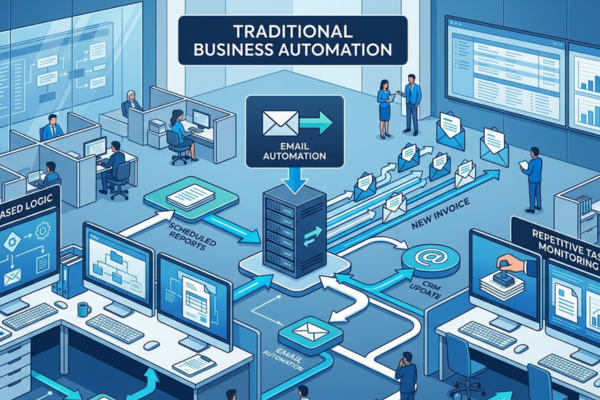
- Auto-reply emails when someone fills out a form
- Invoices that are created using a fixed template
- Stock alerts when items go below a set number
- Social media posts that go live on a schedule
- Data transfers between two systems at set times
Traditional automation is great for simple tasks. It is easy to set up. It does not cost a lot. And it does the same thing correctly every time.
But it has limits. It cannot handle surprises. It cannot learn. It just follows the rules you gave it.
What Is AI Automation?
AI automation is a much smarter kind of automation. It does not just follow rules. It actually thinks.
Machine learning automation allows the system to:
- Look at large amounts of data
- Find patterns and trends
- Make decisions based on what it finds
- Keep learning and improving on its own
How AI Automation Works Step by Step
- It collects data from different places
- It studies that data using machine learning
- It builds a way to make decisions
- It uses that to handle new situations
- It keeps learning from every new piece of data
Common Examples of AI Automation
- AI chatbots that talk to customers like a real person
- Fraud detection that spots unusual activity right away
- Product suggestions based on what a customer likes
- Predictive maintenance that spots problems before they happen
- Smart email tools that score leads and sort messages
- Content filters that remove bad content on platforms
AI automation solves problems that traditional systems cannot even notice. That is the real power of intelligent automation software.
You can visit Arena.ai’s platform to see how AI automation is being used in real business settings today.
AI Automation vs Traditional Automation: Key Differences
Let us look at both side by side. This makes it easy to see what sets them apart.
Feature Comparison Table
| Feature | Traditional Automation | AI Automation |
| How it decides | Follows fixed rules only | Uses data to make smart choices |
| Can it learn? | No | Yes — it learns and improves |
| How flexible is it? | Not very flexible | Very flexible and adaptable |
| How hard is setup? | Easy | Medium to hard |
| What if something changes? | Cannot adjust | Handles changes on its own |
| Best use | Simple, repeated tasks | Complex and changing tasks |
| Needs human help? | Yes, for updates | Very little after setup |
| Starting cost | Low | Medium to high |
| Long-term value | Good | Excellent |
| Works with other tools? | Limited | Yes, very well |
This table gives you a clear look at the difference between AI and automation in its traditional form.
Both types are useful. The right choice depends on what your business really needs.
Key Benefits of AI Automation Every Business Owner Should Know
AI automation benefits go way beyond just saving a bit of time. Here is what you truly gain when you use AI automation in your business:
It Makes Things Faster
- Tasks that used to take hours now take seconds
- No waiting around for someone to do it manually
- Everything runs on its own day and night
It Reduces Mistakes
- AI does not get tired or distracted
- It catches errors before they cause problems
- Your output stays clean and consistent
It Improves Customer Experience
- AI chatbots reply to customers right away
- Customers get a personal experience every time
- Faster replies mean happier customers
It Saves Money Over Time
- Less need for manual staff on repetitive tasks
- Fewer mistakes mean fewer costly fixes
- You scale up without hiring a full new team
It Gives You Better Information
- AI looks at your data in real time
- It shows you what is working and what is not
- You make smarter decisions faster
It Grows with Your Business
- AI tools scale up easily
- You do not have to rebuild everything as you grow
- Just add new workflows when you need them
We helped one client achieve exactly these results. See how we delivered results in this HereApp project, where smart automation and development came together to build something truly scalable. This real-life example shows what the right technology choices can do for a growing business.
Key Benefits of Traditional Automation for Businesses
Traditional automation still has a strong place in business. Do not count it out.
Why Traditional Automation Still Works Well
- Low upfront cost — easy to budget, especially for small businesses
- Easy to set up — no need for AI experts or data scientists
- Very reliable — does the same task perfectly every single time
- Easy to check — every rule is clear and can be reviewed
- Fast results — set it up quickly and see the results fast
- Great for compliance — follows your rules exactly as written
Best Situations for Traditional Automation
- Running payroll on a set schedule
- Sending order confirmation emails
- Creating weekly reports automatically
- Moving files from one place to another
- Backing up data at a set time every day
If your business has simple, predictable tasks, traditional automation does the job well. And it costs a lot less to start.
📌 Which Is Better: AI Automation or Traditional Automation?
There is no one right answer for everyone. Traditional automation works best for simple tasks that never change and have a limited budget. AI automation works best for complex tasks that involve lots of data and need smart decisions. For most businesses in 2025, using both together gives the best results.
Business Value: What Automation Does for Your Growth
Here is the real value of automation for businesses, no matter which type you use:
What Automation Gives Your Business
- ✅ Lower running costs — spend less on manual work every day
- ✅ Better accuracy — fewer errors in your most important processes
- ✅ Faster delivery — tasks are done in seconds, not hours
- ✅ Always-on support — automated systems help customers 24/7
- ✅ Real-time insights — see what is happening in your business right now
- ✅ More productive team — your people focus on important work, not repetitive tasks
- ✅ Stay ahead of competitors — while others do things manually, you are running smart
- ✅ Grow without high costs — scale your operations without hiring lots of new people
- ✅ Consistent quality — the same great result every single time
- ✅ Faster decisions — data helps you choose the right path quickly
These benefits work across all kinds of businesses: shops, clinics, finance firms, tech companies, and more.
We saw this play out for a real client. Explore this business transformation case study, Neuro Ascent, to see how automation and smart development helped unlock major growth. This real-life example is perfect for any business owner thinking about their next technology investment.
Automation Cost Comparison: What Should You Budget?
Cost is always a big question. Here is a simple and honest look at what different automation solutions usually cost.
Automation Investment Table
| Automation Type | Estimated Cost | Best For |
| Basic Traditional Automation | $500 – $5,000 | Small businesses with simple workflows |
| Advanced Rule-Based Automation | $5,000 – $20,000 | Mid-size businesses with multi-step tasks |
| AI Chatbot Automation | $10,000 – $50,000 | Customer support and lead generation |
| AI Workflow Automation | $20,000 – $80,000 | Sales, HR, and operations teams |
| Machine Learning Automation | $50,000 – $150,000 | Complex data tasks and predictions |
| Enterprise AI Automation | $100,000+ | Large businesses with big, complex needs |
Things That Affect the Final Cost
- How complex your workflows are
- How many tools need to be connected
- How much data the system needs to handle
- How much customization you need
- Ongoing support and maintenance
Knowing these numbers helps you plan better. You can start small and grow from there.
How to Choose the Right Automation for Your Business
Not every business needs the same thing. Here is a simple way to figure out what is right for you.
Pick Traditional Automation If:
- Your tasks are simple and happen the same way every time
- You are working with a smaller budget
- You want to get up and running quickly
- Your workflows do not change very often
- You want something easy to manage without tech experts
Pick AI Automation If:
- You work with lots of data that changes often
- You want your system to get smarter over time
- You talk to a large number of customers regularly
- You need the system to predict things and give you smart suggestions
- You want to grow without needing to hire a big team
Think About a Hybrid Approach If:
- Some of your tasks are simple, and some are complex
- You want to start with traditional and add AI later
- You need something that is affordable now but can grow with you
Most successful businesses use a mix of both. Simple tasks go to traditional automation. Complex, data-heavy tasks go to AI automation.
We helped one business find this exact balance. Review this eCommerce success story, Stable Hub, to see how the right mix of tools created a powerful, high-performing platform. This real-life example shows what smart choices can do for any business looking to grow.
The Future of Business Automation
The future of business automation is very exciting. And it is already starting to happen all around us.
Here is where things are going:
Big Trends That Are Shaping the Future
- Hyperautomation — combining AI, machine learning, and traditional tools all together
- No-code AI tools — business owners build automation without writing a single line of code
- AI agents — systems that handle entire tasks from start to finish on their own
- Predictive automation — workflows that start before a problem even happens
- Voice and chat automation — you talk to your automation tools like a real person
- Edge AI — automation that runs on local devices without needing the internet
What This Means for Your Business
- Automation will become cheaper and easier to use
- Even small businesses will be able to afford smart AI tools
- More jobs will shift to creative and strategic thinking
- Businesses that start now will be miles ahead in a few years
- Every industry will be touched by automation in some way
According to OpenAI, the next wave of AI will create tools that can reason, plan, and run whole business workflows on their own. That future is not far away.

Start Your AI Automation Project
Are you ready to stop doing everything manually and start working smarter?
Whether you need:
- A simple automation system to save a few hours each week
- An AI-powered workflow that grows with your business
- A fully custom automation solution built just for you
- A platform that connects all your business tools together
Ropstam is ready to help.
We build smart, scalable automation systems and custom software that get real results. We work with startups, growing businesses, and large companies. We do not just build technology — we solve real business problems with it.
If you want to start your project, contact us here. Tell us what you need, and we will build the right solution for you.
Conclusion
AI Automation vs Traditional Automation is not really a fight. It is simply a choice.
- Traditional automation is reliable, affordable, and great for simple tasks
- AI automation is smart, flexible, and built for growing businesses
- Using both together often gives you the very best results
The right choice depends on where your business is today and where you want it to go. Either way, automation saves you time, cuts your costs, and helps you grow faster.
Do not wait while your competitors get ahead. Start automating your business today.
If you want to start your project, contact us here. Our team at Ropstam is ready to help you build the right automation solution one that fits your goals, your budget, and your business.
FAQs
1. What is the main difference between AI automation and traditional automation?
Traditional automation follows fixed rules that you set. It always does the same thing. AI automation learns from data. It can handle new situations, make smart choices, and get better over time on its own.
2. Is AI automation too expensive for small businesses?
Not always. Many AI tools are now very affordable. You can start small and grow as your business grows. The right development partner will help you find a solution that fits your budget.
3. Can traditional automation and AI automation work together?
Yes, absolutely. Many businesses use both. They use traditional automation for simple tasks and AI automation for more complex work. This gives you the best results without overspending.
4. How long does it take to set up AI automation?
It depends on what you need. Simple AI tools can be ready in a few weeks. Bigger, more complex systems can take anywhere from two to six months. It all depends on how much customization and integration is needed.
5. Which industries benefit most from AI automation?
AI automation works great in many industries:
- eCommerce — smart product suggestions and stock management
- Healthcare — patient records and booking systems
- Finance — fraud alerts and automated reporting
- Logistics — route planning and demand forecasting
- Customer service — AI chatbots and fast automated replies