With the ever-increasing significance attributed to data, the ways of storing and analyzing it have become equally important. Databases play a pivotal role in the storage, retrieval, and organization of data for any business. The two most well-known database types are relational databases and graph databases.
The one aspect that every database analyst and engineer is concerned with is the selection of the ideal database for storing critical data. This article digs into the graph database vs. relationship database debate, illustrating the differences between the two renowned categories of database management systems.
Difference Explained Between Relational and Graph Database
Relational databases use tables with rows and columns, maintaining data integrity with constraints. On the contrary, graph databases, lacking a predefined schema, use nodes and edges for flexibility, ideal for specific business needs.
Graph Database vs. Relational Database – Which is Best for Your Development Project?
Let’s start by defining the relationship database. In a relational database, data is organized in the form of rows, columns, and tables, and the relationship between tables is also part of the structure. Constraints – rules that ensure each column must contain distinct values – are utilized to maintain data integrity in a relational database.
On the other hand, a graph database does not consist of a predefined schema. In contrast to rows and columns, nodes and edges define a graph database. Each node and edge possess unique properties explaining the relationship. Since such databases don’t have a predefined schema, they are more flexible and much easier to tailor according to peculiar business needs.
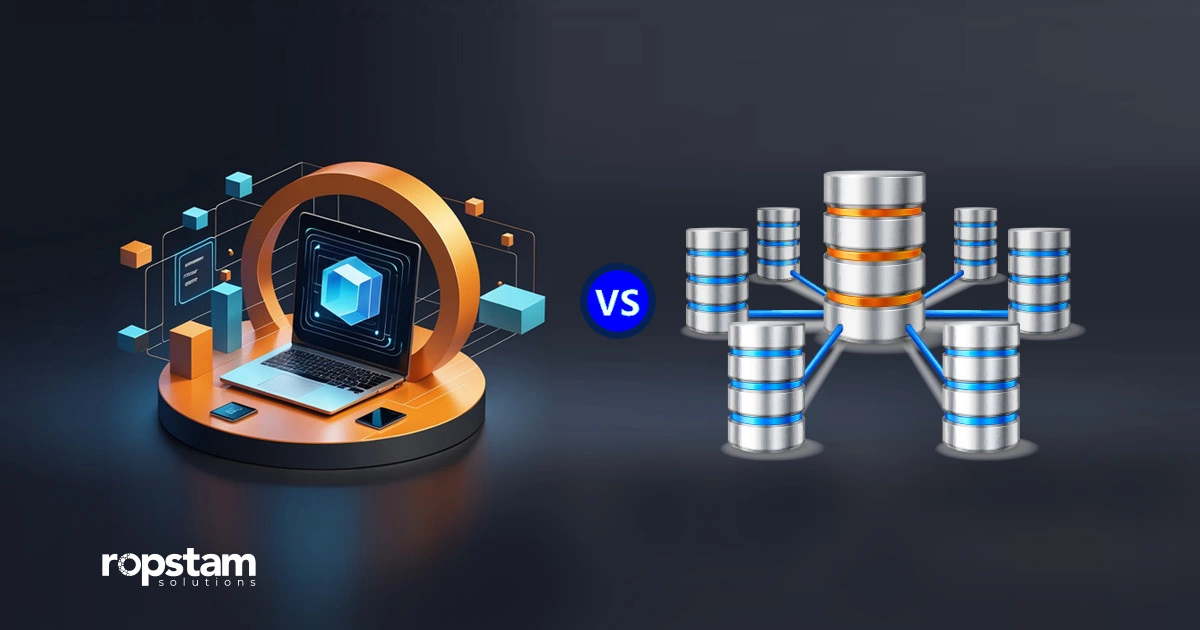
The comparison between Graph Databases and Relational Databases is at the heart of the data management debate, as each offers a distinct set of strengths and weaknesses. To help you understand this fundamental distinction, let’s delve into ten factors that differentiate these two renowned categories of DBMSs (database management systems).
- Data Structure
- Data Relationships
- Schema Flexibility
- Query Language
- Performance
- Scalability
- Complexity
- Use Cases
- Development Time
- Maintenance and Evolvability
1) Data Structure:
A fundamental difference lies in the data structure. Relational databases organize data into structured tables with rows and columns, making them ideal for well-defined and structured data. In contrast, graph databases employ nodes and edges to represent data relationships, a better fit for complex, interconnected data.
2) Data Relationships:
Graph databases excel in handling complex relationships, allowing efficient modeling and querying of intricate connections between entities, such as social networks or recommendation systems. Relational databases are less intuitive for such tasks.
3) Schema Flexibility:
Relational databases require a predefined schema, which can be limiting when dealing with evolving or semi-structured data. Graph databases offer schema flexibility, accommodating changes as data evolves.
4) Query Language:
Relational databases commonly use SQL for querying. In contrast, graph databases use graph query languages like Cypher, which are designed to express relationships more effectively.
5) Performance:
In scenarios where relationship traversal is frequent, graph databases outperform relational databases. However, relational databases offer better performance for simple and static data structures.
6) Scalability:
Graph databases tend to scale well for relationship-heavy data, making them a preferred choice for scenarios with data growth or complex relationships. Relational databases might struggle to scale efficiently for certain use cases.
7) Complexity:
Relational databases are easier to set up and maintain for simple data models. Graph databases can be more complex to design and query but offer better performance for complex relationship-based data.
8) Use Cases:
Relational databases suit well-structured data and tabular arrangements, often seen in financial applications or inventory management. On the other hand, graph databases shine in applications like social networks, recommendation systems, and fraud detection.
9) Development Time:
Relational databases require careful schema design, which can be time-consuming. Meanwhile, graph databases require less upfront design and are quicker to implement for relationship-centric scenarios.
10) Maintenance and Evolvability:
When data models transform, graph databases provide flexibility without necessitating significant schema changes. In contrast, relational databases may require extensive schema adjustments when data structures change.
When to Use a Graph Database? (Use Cases)
Graph databases excel in various use cases where the understanding of complicated relationships is paramount. Let’s explore some practical scenarios:
1) Social Networks
In the realm of social networks, graph databases play a pivotal role in capturing the complexities of human connections. These databases easily encompass the complex web of friendships, followers, and interactions. By doing so, they empower the efficient functioning of recommendation algorithms and personalized content delivery, significantly enhancing user engagement.
2) Recommendation Engines
The effectiveness of recommendation systems largely hinges on the database’s ability to comprehend user preferences and connect them with pertinent content or products. Graph databases shine in this arena, as they are engineered to comprehend intricate relationships between users and items, be it in e-commerce, content streaming, or other domains. This deep understanding of user-item relationships is paramount for enhancing user satisfaction and driving conversions.
3) Fraud Detection
Graph databases are instrumental in fraud detection by helping uncover irregular and suspicious connections within data. The detection of fraudulent activities often relies on identifying unusual patterns and relationships that might go unnoticed with conventional database systems. Graph databases are well-equipped to navigate complex networks of data, making them indispensable for preempting fraudulent behavior.
4) Knowledge Graphs
Building knowledge graphs is a specialized use case where graph databases thrive. In the quest to organize vast repositories of information, graph databases shine by enabling semantic searches and exploration of interconnected knowledge. The relationships between various pieces of information are preserved, offering a comprehensive understanding that conventional databases struggle to provide.
5) Real-time Decision Support:
In scenarios demanding real-time, data-driven decisions, graph databases offer a critical advantage. They swiftly reveal the relationships and connections within data, allowing organizations to make informed decisions on the spot. Whether it’s optimizing logistics, responding to market changes, or managing IoT data, the ability to navigate complex relationships is a game-changer.
When to Use a Relational Database? (Use Cases)
Now, let’s explore the case studies where a relational database is the optimal choice and delve into the considerations of when to use one:
1) Structured Data:
Relational databases excel in scenarios where the data structure is well-established and unchanging. If your data can be neatly organized into tables with predefined columns and relationships, a relational database is a natural choice. It’s the go-to option for structured and tabular data.
2) Complex Queries with Joins:
When your application requires complex queries involving multiple tables and joins, a relational database, with its powerful SQL language, is highly suitable. SQL excels in querying structured data and can efficiently handle intricate relationships.
3) ACID Compliance:
If your application demands strong ACID (Atomicity, Consistency, Isolation, Durability) compliance, which ensures data integrity and reliability, a relational database is the preferred choice. It’s especially vital for applications like financial systems and healthcare records.
4) Large Volumes of Structured Data:
Relational databases can handle substantial volumes of structured data efficiently. They are known for their robustness in managing large datasets, making them an excellent fit for applications requiring extensive data storage.
5) Transactions and Data Integrity:
In scenarios where transactions are a core aspect of your application, such as e-commerce or banking, a relational database’s transaction management capabilities and data integrity features are invaluable. These systems ensure that complex transactions occur reliably.
6) Mature Ecosystem and Tools:
Relational databases boast a mature ecosystem with a vast array of tools and a wealth of expertise available. This is advantageous for development, maintenance, and troubleshooting.
7) Data Security and Access Control:
When data security and fine-grained access control are paramount, relational databases offer a robust framework for managing user permissions and protecting sensitive information.
8) Well-Defined Schema Changes:
If your application undergoes well-defined schema changes infrequently, relational databases accommodate these changes systematically. This is advantageous in situations where the data structure remains relatively stable.
Advantages and Disadvantages of Graph Database
Pros
- Graph databases are best for managing complex relationships
- You can do dynamic schema changes
- Queries involving deep relationships are quicker
- The Cypher query language makes querying effortless
Cons
- Managing graph data can be more complex
- Graph databases may encounter scalability issues
- Smaller user base
- Can be resource-intensive for simple data storage & retrieval
Advantages
Following are the advantages of using a graph database:
- Graph databases excel in managing complex relationships, making them suitable for applications like social networks and recommendation systems.
- They allow dynamic schema changes and accommodate evolving data structures without disruptions.
- Queries involving deep relationships are faster in graph databases than in relational databases.
- The Cypher query language in graph databases simplifies querying and makes it more intuitive.
Disadvantages
Here are the disadvantages of using a graph database:
- Managing graph data can be more complex than structured tabular data in relational databases.
- Graph databases might face scalability issues with extremely large datasets or complex queries.
- Such databases have a smaller user base than relational databases, resulting in fewer resources and tools.
- For simple data storage and retrieval, graph databases can be resource-intensive and may not be the most efficient choice.
Advantages and Disadvantages of Relational Database
Pros
- Suitable for structured, tabular data with clear relationships
- High-end practices, tools, and support
- Offers robust scalability features
- Very much reliable option
Cons
- May make queries slower
- Difficult to change the schema
- Slower query performance in some cases
- A steeper learning curve for new developers
Advantages
Ahead, the advantages of using a relational database:
- Relational databases are well-suited for structured, tabular data with clear relationships.
- They have a long history and well-established best practices, tools, and support.
- Many relational databases provide robust scalability features for handling large datasets.
- Relational databases enforce data integrity through ACID properties, ensuring reliability.
Disadvantages
Below are the disadvantages of using a relational database:
- Complex relationships may require multiple tables and joins, making queries slower.
- Altering the schema can be challenging and time-consuming.
- In scenarios with deep, interconnected data, relational databases may suffer from slower query performance.
- Some relational databases can have a steeper learning curve, especially for beginners.
Conclusion
In today’s technologically advanced era, databases are an integral part of the software development process. Selecting the optimal database is the cornerstone of efficient data storage, retrieval, and management. In this blog, I have evaluated the comparison of Graph database and Relational database in detail, underlining the key deciding factors.
If you’re in need of top-notch web, iOS & android app, or software development services, don’t hesitate to reach out to Ropstam Solutions. Our team of experts is ready to assist you in bringing your digital ideas to life, ensuring custom-build solutions that meet your unique requirements. Contact us today for modern technology solutions that can transform your business.