Artificial intelligence is changing how companies work. It saves time, cuts errors, and boosts profits. But many leaders worry about the AI project cost before they begin. Smart planning turns that worry into clear action. When you know how to estimate AI development cost early, you avoid surprise fees and wasted mqonths. This guide walks you through every step of AI project budget planning so you can control your AI project cost from day one. You will learn what drives prices, how to pick the right pricing model, and where to save money without losing quality. We keep things simple and focused on real business results. Ready to move forward with confidence? Visit this page to start your project today. Our team helps you map out a clear path, set a realistic budget, and launch an AI tool that grows with your company. Let’s break down the numbers so you can build smarter, spend wisely, and win faster.

Why AI Project Cost Matters for Modern Businesses
Money drives every business decision. The AI project cost shapes your timeline, your team size, and your final results. If you guess wrong, you lose cash and momentum. If you plan well, you gain a strong market edge. Here is why tracking the AI project cost early matters:
- It stops budget leaks before they start.
- It helps you pick the right features first.
- It keeps your team focused on real goals.
- It makes it easier to measure ROI later.
- It reduces the risk of project delays.
- It prevents vendor scope creep.
- It aligns stakeholders on financial limits.
- It protects your cash flow during testing.
Many companies rush into AI without a clear plan. They add too many features. They ignore hidden fees. Then they wonder how much does AI cost to build when the bill arrives. Smart leaders do the opposite. They study the AI project cost upfront. They set clear limits. They track every dollar. You can see how we delivered results in this project by reviewing our past work. When budgets are tight, clear planning wins. Learn from this real client example at to see how careful cost tracking led to a smooth launch and strong returns.
How Budget Control Drives Growth
Controlled spending fuels steady growth. You reinvest savings into marketing. You fund customer support upgrades. You hire key staff faster. The AI project cost becomes a growth lever. You scale only what works. You cut what fails. You build a repeatable system. This approach turns AI from a cost center into a profit driver. You gain market share. You outpace slower competitors. You build a resilient business model.
What Is AI Development for Business?
AI development means building smart tools that learn from data. These tools automate tasks, predict trends, and answer customer questions. For business owners, AI is not about complex code. It is about solving daily problems faster. You might want a chatbot for support. You might need a system that sorts invoices. You might want a dashboard that forecasts sales. All of these start with a clear plan and a known AI project cost.
What Are AI Costing Tips Every Beginner Should Know?
AI costing tips are simple rules that help you plan your budget before development begins. They focus on scoping features, picking the right tech, and tracking hidden fees so your AI project cost stays under control.
Common Business AI Use Cases
- Customer service automation and routing
- Sales forecasting and lead scoring
- Inventory tracking and demand planning
- Document processing and data extraction
- Marketing personalization and campaign tuning
- Fraud detection and risk scoring
- Employee onboarding and HR support
- Quality control and defect detection
Each use case changes the AI project cost. Simple chatbots cost less. Complex forecasting tools cost more. The difference lies in data volume, model complexity, and integration depth. Pick one core problem first. Solve it well. Then expand. This keeps spending tight and results clear.
Why Custom AI Beats Off-the-Shelf Tools
Generic tools rarely fit unique workflows. They force you to change your process. They limit your data control. They add monthly licensing fees. Custom AI matches your exact needs. It uses your own data. It scales with your growth. The upfront AI project cost may look higher. But long-term savings are larger. You avoid vendor lock-in. You own the system. You control updates. You build a lasting asset.
Key Benefits of Smart AI Project Cost Planning
Planning your AI project cost is not just about saving money. It is about building a stronger company. When you map out expenses early, you unlock clear business gains. Here is what smart planning delivers:
- Faster decision cycles with clear budget limits
- Improved accuracy in forecasting and resource allocation
- Higher customer satisfaction through targeted AI features
- Stronger team alignment around shared financial goals
- Lower risk of scope creep and missed deadlines
- Better vendor negotiations with transparent pricing data
- Quicker time to market with phased rollouts
- Higher ROI through focused feature prioritization
- Reduced stress during testing and launch phases
- Clearer communication with investors and board members
Each benefit ties directly to your bottom line. You spend less on guesswork. You invest more in proven tools. You also gain peace of mind. When you know the AI project cost upfront, you can adjust quickly. You can shift funds to high-impact areas. You can pause low-value tasks without panic. This control turns AI from a risky experiment into a steady growth engine. Explore this business transformation case study to see how structured budgeting helped a mid-sized brand scale its AI tools without overspending.
How Planning Improves Team Performance
Clear budgets reduce team friction. Developers know what to build. Designers know what to prioritize. Managers know what to track. The AI project cost becomes a shared target. Everyone works toward the same goal. Meetings stay short. Decisions stay fast. Output stays high. You avoid endless revision cycles. You launch with confidence.
How Planning Protects Customer Experience
Rushed AI tools frustrate users. They give wrong answers. They crash under load. They damage brand trust. Proper budgeting prevents this. It funds proper testing. It pays for clean data. It covers security checks. The AI project cost includes quality assurance. Your customers get a smooth experience. They stay loyal. They refer others. You grow faster.
AI Implementation Cost Factors You Must Track
Every AI tool has unique needs. But most projects share the same cost drivers. Knowing these factors helps you control the AI project cost from day one. Here are the main areas to watch:
- Data collection and cleaning expenses
- Model training and computing power fees
- Third-party API usage and licensing costs
- Security, compliance, and privacy safeguards
- User interface design and testing cycles
- Ongoing maintenance and update schedules
- Team size, expertise, and location rates
- Cloud hosting and storage scaling needs
- Integration with existing CRM or ERP systems
- User training and change management support
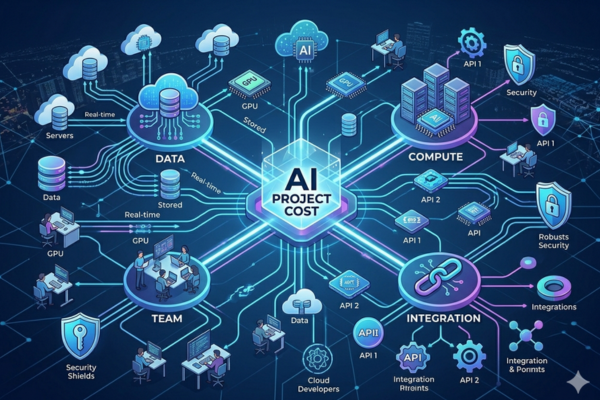
Some factors are fixed. Others change as your project grows. For example, API fees from providers like OpenAI can shift based on usage volume. You can check current rates and usage guides directly on their site. When you map these items early, you avoid surprise bills. You also make it easier to use an AI project cost calculator later. Clear tracking turns vague estimates into solid numbers. This keeps your AI project budget planning on track and your stakeholders happy.
Compute Power and Hosting Fees
AI models need processing power. Training uses heavy compute. Inference uses steady compute. Cloud providers charge by usage. Costs scale with traffic. The AI project cost must include hosting estimates. Pick a plan that matches your peak load. Use auto-scaling to save money. Set spending alerts. Review logs weekly. Adjust resources as demand shifts. This keeps fees predictable.
AI Pricing Models Explained for Business Owners
Vendors charge for AI work in different ways. Picking the right model saves cash and reduces stress. Here is how AI pricing models explained in simple terms:
- Fixed price: You pay one set fee for a clear scope. Best for small, well-defined tools.
- Time and materials: You pay for hours worked and tools used. Best for flexible, evolving projects.
- Retainer model: You pay a monthly fee for ongoing support. Best for long-term AI maintenance.
- Outcome-based: You pay when specific goals are met. Best for performance-driven campaigns.
- Hybrid approach: You mix fixed and hourly rates. Best for complex, multi-phase builds.
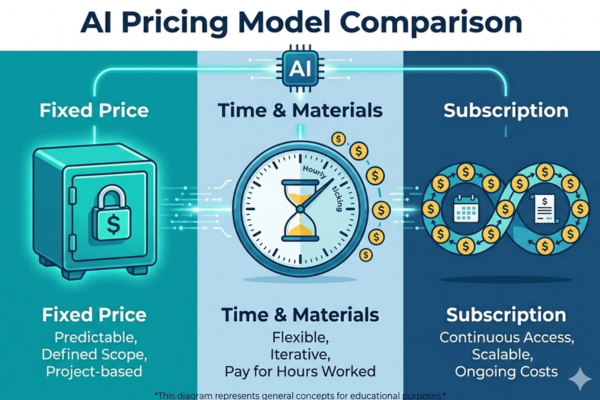
Each model changes how you track the AI project cost. Fixed price limits risk but limits changes. Time and materials allows shifts but needs close tracking. Retainers keep your tool running smoothly. Outcome models tie pay to real results. Choose based on your team size, your timeline, and your comfort with change. When in doubt, start with a small pilot. Test the model. Then scale what works. This keeps your AI project cost steady and your cash flow healthy.
| Pricing Feature | Business Benefit |
| Fixed scope cap | Stops budget overruns early |
| Hourly tracking | Pays only for work done |
| Monthly retainer | Keeps AI tools updated safely |
| Milestone payments | Links cost to real progress |
| Usage-based APIs | Scales fees with actual demand |
When to Choose Fixed Price Contracts
Fixed price works for clear goals. You know the features. You know the data. You know the timeline. The AI project cost stays locked. Vendors absorb the risk. You get predictable billing. This model suits chatbots, simple dashboards, and standard integrations. Avoid it for vague scopes. Changes will cost extra. Keep the scope tight. Sign off on details first.
When to Choose Time and Materials
Flexible projects need flexible billing. You may discover new data sources. You may pivot features mid-build. Time and materials adapts fast. You pay for actual effort. The AI project cost shifts with scope. You must track hours daily. You must approve changes weekly. This model suits complex workflows, custom models, and enterprise systems. It rewards transparency. It demands active management.
How to Estimate AI Development Cost Step by Step
Estimating the AI project cost does not require a finance degree. It just takes a clear process. Follow these steps to build a solid number:
- List your core business goals first.
- Pick only the features that meet those goals.
- Map out your data sources and quality levels.
- Choose a hosting plan that fits your traffic.
- Ask vendors for detailed line-item quotes.
- Add a 15 percent buffer for testing and fixes.
- Review the machine learning project cost estimation with your team.
- Lock the scope before any code is written.
- Set monthly spending caps for cloud services.
- Schedule bi-weekly budget check-ins with stakeholders.
This method removes guesswork. It forces clear choices. It also makes it easier to compare vendors. You can also study market benchmarks from trusted research hubs like arena.ai to see how industry leaders structure their AI spend. When you follow a steady process, the AI project cost becomes a tool, not a trap. You gain control. You gain clarity. You gain the power to say no to low-value add-ons. That discipline is what separates successful launches from costly delays.
Step 1: Define the Problem Clearly
Vague problems create vague budgets. Write down the exact pain point. Measure how much it costs now. Set a clear success metric. The AI project cost should tie to that metric. If the tool saves $50k yearly, a $30k build makes sense. If it saves $5k yearly, pause and rethink. Numbers guide decisions. Emotions cause overspending. Stick to the data.
Step 2: Audit Your Existing Data
AI runs on data. Check what you have. Note gaps and errors. Estimate cleaning hours. Factor this into the AI project cost. Poor data raises training fees. It delays launches. It lowers accuracy. Clean data speeds everything up. It reduces compute time. It improves predictions. Budget for data work first. Build the model second. This order saves money.
10 Essential AI Costing Tips Every Business Owner Should Know
What Is an AI Project Cost Calculator and How Does It Help?
An AI project cost calculator is a planning tool that breaks down expected expenses by feature, data size, and hosting needs. It gives business owners a quick baseline so the AI project cost stays transparent from day one.
Now, here are ten practical tips to keep your budget tight:
- Start with a minimum viable product to test demand.
- Clean your data before you train any model.
- Avoid custom code when proven APIs work fine.
- Set hard limits on monthly cloud spending.
- Track API calls and set automatic alerts.
- Review vendor contracts for hidden renewal fees.
- Plan for compliance checks early in the timeline.
- Schedule weekly budget reviews with your lead developer.
- Pause low-impact features until phase two launches.
- Measure ROI after every major update cycle.
These tips cut waste fast. They keep your team focused. They also make AI project budget planning a habit, not a one-time task. When you apply them consistently, you lower the AI development cost per project without losing quality. You build smarter. You spend less. You scale with confidence.
Tip 1: Prioritize High-Impact Features
Not all features drive revenue. Some just look nice. Rank features by business value. Build the top three first. Defer the rest. The AI project cost drops sharply. You launch faster. You gather real user feedback.
Tip 2: Negotiate Vendor SLAs Clearly
Service level agreements protect your budget. Define uptime guarantees. Set response time limits. Outline penalty clauses. Vendors respect clear terms. The AI project cost stays predictable. You avoid downtime losses. You get faster support. You reduce operational friction. Read every line. Ask questions. Sign only when terms match your needs.
AI Software Development Cost Breakdown by Service Type
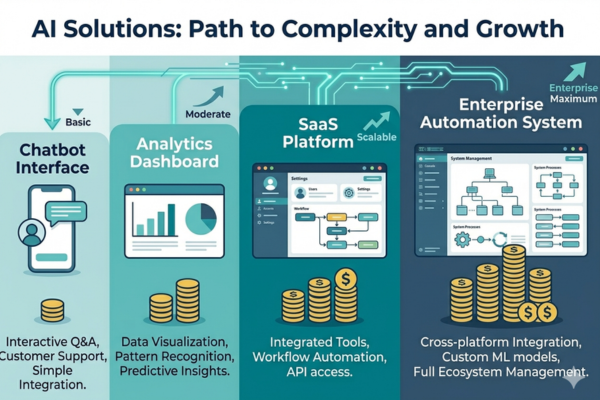
Not all AI tools cost the same. The price shifts based on complexity, data needs, and user volume. Here is a clear AI software development cost breakdown to help you plan:
| AI Development Type | Estimated Cost |
| AI Customer Chatbot | $10k – $50k |
| Predictive Analytics Dashboard | $30k – $90k |
| AI-Powered SaaS Platform | $50k – $200k |
| Enterprise Workflow Automation | $100k – $350k |
| Custom Machine Learning Model | $80k – $250k |
These ranges reflect real market rates. They include design, development, testing, and launch support. They do not include long-term hosting or heavy data licensing. Those items add to the final AI project cost over time. You can lower these numbers by reusing existing data, picking lighter models, and launching in phases. Many brands see how we delivered results in this project by starting small and scaling only after proving ROI. Review this eCommerce success story to see how a phased rollout kept costs low while boosting sales fast. When you match the tool to your actual needs, the AI project cost stays fair and predictable.
Why Chatbots Cost Less Than Custom Models
Chatbots use proven frameworks. They rely on existing APIs. They need less training data. The AI project cost stays low. Custom models require unique data. They need heavy compute. They demand expert tuning. Prices rise accordingly. Pick chatbots for support tasks. Pick custom models for core IP. Match the tool to the goal. Save money by avoiding over-engineering.
How Enterprise Automation Scales Costs
Enterprise tools touch many systems. They integrate with ERPs. They sync with CRMs. They handle strict compliance. The AI project cost reflects this complexity. You pay for security audits. You pay for data mapping. You pay for user training. But the ROI is massive. You cut manual labor. You reduce errors. You speed up workflows. Budget for depth. Expect higher upfront fees. Enjoy long-term savings.
Start Your AI Development Project
AI works best when it sits on a strong digital foundation. Our team builds scalable WordPress solutions, custom web builds, and fast business websites that connect smoothly with AI tools. We handle the tech so you can focus on growth. We map out your features, track your budget, and launch in clear phases. No hidden fees. No vague promises. Just steady progress and real results. If you want to start your project, contact us here. Let’s turn your AI vision into a working system that saves time, cuts costs, and drives revenue.
Conclusion
Planning the AI project cost is the smartest step you can take before development begins. It protects your budget, aligns your team, and turns complex tech into clear business value. When you track key factors, pick the right pricing model, and follow proven costing tips, you avoid costly mistakes. You launch faster. You scale safer. You keep your cash flow strong. AI is not a guessing game. It is a measured investment. With the right plan, every dollar works harder for your company. If you want to start your project, contact us here. Let’s build an AI solution that fits your goals, respects your budget, and delivers real growth.
FAQs
How much does AI cost to build for a small business?
Most small business AI tools range from $10k to $50k. The final AI project cost depends on data size, feature count, and hosting needs. Start small to keep early costs low.
What is the biggest hidden fee in AI development?
Data cleaning and API usage often surprise teams. These items add up fast. Track them early to keep your AI project budget planning accurate and stress-free.
Can I use an AI project cost calculator for accurate estimates?
Yes, but only as a starting point. Calculators give baseline numbers. Real quotes require a detailed scope review and a clear feature list.
How will the cost of AI development 2026 change?
Prices will likely drop for basic models but rise for custom enterprise systems. Cloud fees and compliance rules will also shape the final AI project cost.
Is machine learning project cost estimation different from standard AI?
Yes. Machine learning needs more data, longer training cycles, and higher compute power. This raises the AI development cost per project but often delivers deeper insights.