
AI business automation is transforming how modern companies operate, especially in today’s fast-moving digital economy. Businesses are constantly under pressure to reduce operational costs, increase efficiency, and deliver faster, more personalized customer experiences. Relying on manual processes is no longer sustainable, as they are time-consuming, error-prone, and difficult to scale. This is where AI automation becomes a game-changing solution for organizations of all sizes. With the help of intelligent systems, companies can now automate repetitive and rule-based tasks that once required significant human effort. These include data entry, report generation, scheduling, email responses, and even basic customer queries. By reducing manual workload, AI enables employees to focus on higher-value activities such as strategy, innovation, and decision-making.
Another key benefit is scalability. As businesses grow, manual systems often become overwhelmed. AI-powered solutions, however, can easily scale without compromising speed or accuracy. This makes them ideal for startups, SMEs, and large enterprises alike. For a mobile app development company, AI automation is even more impactful. It helps streamline workflows, improve app performance monitoring, and accelerate delivery cycles. Businesses adopting AI tools for business productivity are already seeing faster growth, improved accuracy, and reduced operational workload.
This blog explores 10 game-changing business tasks you can automate using AI today. You will also learn how to use AI in business operations, explore AI workflow automation, and understand practical strategies to implement automation effectively. By the end, you will clearly understand how to automate business processes using AI and unlock smarter growth for your organization. Start your journey today with Ropstam.

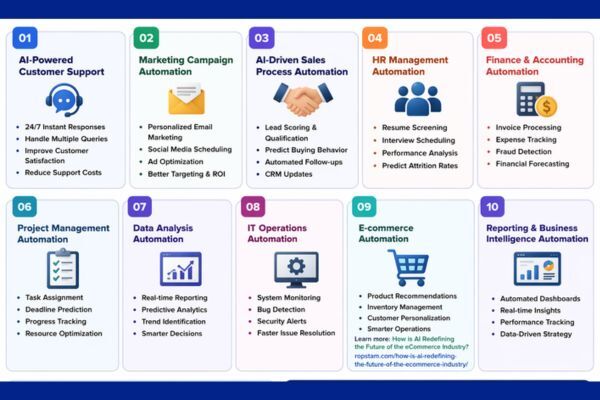
1. AI-Powered Customer Support Automation
Customer support is one of the most time-consuming business functions. With AI business automation, companies can now handle customer queries faster and more efficiently without increasing team size.
How AI transforms support operations
AI-powered chatbots and virtual assistants can:
- Respond to customer queries 24/7
- Handle multiple requests at once
- Provide instant solutions
- Reduce human workload
This is a core example of business tasks automation with AI, especially for mobile app companies dealing with global users.
Benefits of AI customer support automation
Using AI tools for business productivity, companies can:
- Reduce response time by 70%
- Improve customer satisfaction
- Lower operational costs
- Ensure consistent communication
AI systems also learn from past interactions. This improves accuracy over time and reduces repetitive queries. AI chatbots are transforming how businesses deliver customer service by enabling instant responses, 24/7 support, and improved customer engagement. These intelligent systems help reduce operational costs while enhancing user satisfaction through faster and more accurate query resolution. As companies continue to adopt automation, AI chatbots are becoming a key part of digital transformation strategies, allowing support teams to focus on more complex and value-driven tasks.
Real-world use cases
- App support chatbots resolving login issues
- AI ticketing systems categorizing complaints
- Voice assistants guiding users through troubleshooting
Business value
AI customer support automation improves brand reputation and retention. According to industry research by McKinsey & Company, AI-driven customer service can reduce operational costs by up to 30%. This is one of the most impactful ways to automate business processes using AI today.
2. Marketing Campaign Automation with AI
Marketing is changing faster than ever, thanks to smarter technology that helps businesses work more efficiently. Instead of relying only on manual methods, companies now use intelligent tools to understand customer behavior, spot trends, and create personalized campaigns. This helps them reach the right people at the right time, improve customer engagement, and increase sales.
With AI automation, marketing teams can streamline repetitive tasks such as email scheduling, social media posting, and ad campaign management. AI also helps in A/B testing, performance tracking, and real-time optimization, ensuring that campaigns deliver maximum ROI. As a result, businesses can make data-driven decisions faster, reduce wasted ad spend, and focus more on creative strategy and brand growth.
AI in modern marketing
AI can:
- Analyze customer behavior
- Predict campaign performance
- Automate email marketing
- Generate content ideas
This makes AI workflow automation essential for digital marketing teams.
Key advantages
With AI for small business automation, marketing becomes:
- Faster
- Data-driven
- Highly targeted
- Cost-efficient
Business impact
Companies using AI productivity tools for companies see:
- Higher conversion rates
- Better ROI on ads
- Reduced manual effort
Marketing automation ensures every campaign is optimized in real time. This is a strong example of AI automation strategies for businesses.
3. AI-Driven Sales Process Automation
Sales teams often spend a lot of time on repetitive tasks that reduce their productivity. Today, smart technology can handle many of these routine jobs automatically, making the sales process faster and more efficient. This allows sales teams to spend less time on paperwork and more time building customer relationships and closing deals.
How AI improves sales
AI enhances sales operations by automating and optimizing key activities such as:
- Scoring leads automatically based on behavior and engagement
- Predicting customer buying behavior using historical data
- Sending personalized and automated follow-ups
- Managing CRM updates and data entry tasks
- Identifying high-value prospects in real time
Smart technology helps businesses automate everyday sales tasks, allowing teams to work faster and more efficiently. It can keep track of leads, send timely follow-ups, and organize customer information without constant manual effort. It also provides useful insights that help sales managers make better decisions and predict future sales more accurately. By reducing repetitive work, businesses can focus more on building customer relationships, closing more deals, and increasing overall revenue.
Benefits of sales automation
- Faster deal closures
- Improved lead quality
- Better customer targeting
- Reduced manual tracking
AI sales tools in action
- CRM systems like AI-powered Salesforce automation
- Chatbots qualifying leads
- Predictive analytics for customer behavior
Business value
Using AI tools for business productivity in sales increases revenue predictability and reduces wasted effort. Sales teams can focus on closing deals instead of data entry.
4. Human Resource Management Automation
HR departments benefit significantly from AI automation, as it helps streamline recruitment, onboarding, and employee management processes. Traditional HR tasks often require a lot of manual effort, time, and coordination. However, with AI-powered systems, these workflows become faster, smarter, and more efficient.
AI in HR operations
AI transforms HR functions by automating key responsibilities such as:
- Screening resumes automatically based on job requirements
- Scheduling interviews without manual coordination
- Analyzing employee performance using data-driven insights
- Predicting employee attrition rates to improve retention planning
These capabilities are a strong example of business process automation AI, allowing HR teams to focus more on strategic decision-making rather than repetitive administrative work.
Benefits of AI in HR
By adopting AI tools for business productivity, organizations can achieve:
- Faster and more efficient hiring processes
- Reduced unconscious hiring bias through data-driven selection
- Better workforce planning and forecasting
- Lower HR workload and operational costs
AI also enhances consistency in recruitment and ensures that the best candidates are identified based on objective criteria.
AI HR automation examples
- Chatbots answering employee queries
- AI onboarding systems
- Automated payroll processing
This is a strong example of how to use AI in business operations effectively.
5. Finance and Accounting Automation
Finance teams deal with many repetitive tasks and large amounts of data every day. Smart technology can automate these routine processes, helping businesses save time, improve accuracy, and complete financial tasks more quickly. This not only makes work more efficient but also reduces the chances of mistakes in important financial operations.
AI can automate several key finance tasks that traditionally require a lot of time and resources. These include invoice processing, where AI can extract, verify, and record data automatically; expense tracking, which becomes more accurate and real-time through automated categorization; fraud detection, where AI identifies unusual patterns and potential risks instantly; and financial forecasting, where predictive analytics help businesses make smarter budgeting and investment decisions.
Table: AI in Finance Automation
| Task | AI Function | Benefit |
| Invoicing | Auto processing | Faster payments |
| Fraud detection | Pattern recognition | Improved security |
| Forecasting | Predictive analytics | Better planning |
Business impact
Companies using AI workflow automation in finance reduce human errors and improve accuracy.
6. Project Management Automation
AI capabilities
- Task assignment automation
- Deadline prediction
- Progress tracking
- Resource optimization
Benefits
- Better productivity
- Reduced delays
- Clear communication
- Smarter planning
7. Data Analysis Automation
Data is powerful when used correctly. AI automation helps analyze large datasets quickly.
AI in analytics
- Real-time reporting
- Predictive analytics
- Trend identification
Business value
- Faster decision-making
- Reduced manual analysis
- Improved strategy development
8. IT Operations Automation
IT teams use AI automation to manage systems efficiently.
Automation tasks
- System monitoring
- Bug detection
- Security alerts
Benefits
- Reduced downtime
- Faster issue resolution
- Improved security
Ethical and responsible AI in IT systems
As automation increases, it is also important to ensure fairness, transparency, and accountability in AI-driven systems. Ethical implementation of AI ensures that decisions made by automated systems are explainable and free from bias.
Business impact
For mobile app development companies, AI-powered IT automation ensures apps run smoothly, updates are deployed faster, and system issues are resolved proactively. This improves user experience and strengthens brand reliability.
9. E-commerce Automation
E-commerce is one of the industries that benefits the most from smart technology. Online stores handle thousands of daily tasks, such as updating products, answering customer questions, managing inventory, and recommending products. Doing all of this manually takes a lot of time and can lead to mistakes. That’s why many online businesses now use intelligent tools to handle these tasks faster, more accurately, and with less effort.
How AI transforms e-commerce operations
With business tasks automation with AI, e-commerce businesses can streamline critical processes such as:
- Product recommendation systems
- Dynamic pricing optimization
- Inventory tracking and forecasting
- Customer behavior analysis
- Automated marketing campaigns
AI helps businesses understand customer intent and deliver personalized shopping experiences in real time. This improves engagement and boosts conversions significantly.
Future impact of AI in e-commerce
The future of e-commerce is deeply connected with AI innovation. Businesses that adopt AI automation strategies for businesses will stay ahead of competitors by improving efficiency and scaling faster. AI not only enhances customer experience but also strengthens backend operations, making the entire system more intelligent and adaptive.
10. Reporting and Business Intelligence Automation
Businesses are rapidly evolving with emerging technologies that go beyond traditional automation. Alongside AI automation, companies are now exploring immersive digital experiences powered by VR, AR, and gamified UX to enhance user engagement and interaction. These technologies are reshaping how users interact with apps, websites, and digital products, creating more intuitive and memorable experiences.
AI capabilities
- Automated dashboards
- Real-time insights
- Performance tracking
Case Study: HereApp – Smart Attendance Management Solution
A great example of AI-driven and automation-focused innovation in action is the HereApp developed by Ropstam. HereApp is a smart attendance management system designed specifically for educational institutions to replace traditional, manual attendance methods with a more accurate and efficient digital solution.
Conventional attendance systems often suffer from issues like proxy attendance, human error, and time delays in record-keeping. HereApp solves these challenges by introducing an automated and GPS-based attendance tracking system that ensures only physically present students can mark their attendance. This significantly improves accuracy and accountability within classrooms.
The system also offers flexible attendance marking options, including GPS verification and one-time passcodes, making it both secure and user-friendly. In addition, HereApp provides real-time attendance tracking, detailed reporting, and analytics that help educators identify attendance trends and monitor student engagement more effectively.
From an administrative perspective, the platform reduces manual workload and streamlines classroom management. Teachers and staff can easily manage attendance records, generate reports, and communicate with students through an integrated system. This not only saves time but also improves overall operational efficiency in educational environments. Technically, HereApp is built using modern, scalable technologies that ensure smooth performance across web and mobile platforms. Its intuitive interface makes it easy for all users—students, teachers, and administrators- to interact with the system without technical complexity.
Conclusion
Smart technology is no longer just a nice addition for businesses—it has become an important part of growth. Companies that use intelligent tools to automate routine tasks can work faster, improve productivity, and stay ahead of the competition. From customer support and sales to finance and daily operations, these tools help businesses save time, reduce errors, and make better decisions.
As the business world becomes more competitive, companies need faster, smarter, and more efficient ways to work. Automating everyday processes helps reduce manual work, improves accuracy, and makes it easier to grow without increasing workload. That’s why more businesses are making these technologies a key part of their digital transformation.
Throughout various departments such as marketing, finance, customer service, and human resources, AI is proving its value by handling repetitive and time-consuming tasks with speed and precision. This allows employees to shift their focus from routine operations to more strategic and creative responsibilities that contribute directly to business growth. As a result, organizations not only improve productivity but also enhance overall employee satisfaction and performance.
Another major advantage of AI business automation is its ability to process and analyze large volumes of data in real time. This helps companies gain deeper insights into customer behavior, market trends, and operational performance. With these insights, businesses can make more informed decisions, reduce risks, and identify new growth opportunities more effectively. Now is the time to automate business processes using AI and scale smarter.
FAQs
- What is AI business automation?
AI business automation refers to the use of artificial intelligence technologies to perform repetitive and time-consuming business tasks automatically. It helps companies improve efficiency, reduce manual effort, and increase accuracy. Businesses use it across departments like marketing, finance, and customer support. - Which tasks can be automated using AI?
AI can automate tasks such as data entry, customer support, email responses, scheduling, and reporting. It also helps in marketing campaign management and financial analysis. These automations save time and reduce human errors. - Is AI automation suitable for small businesses?
Yes, AI automation is highly beneficial for small businesses as it reduces workload and operational costs. It allows small teams to handle more work efficiently without hiring additional staff. Many affordable AI tools are available for SMEs. - How does AI improve business productivity?
AI improves productivity by handling repetitive tasks quickly and accurately. It frees employees to focus on strategic and creative work. This leads to better efficiency, faster decision-making, and improved business performance. - Is AI business automation expensive to implement?
Not necessarily. Many AI tools offer scalable pricing based on business needs. Small businesses can start with basic automation tools and upgrade as they grow. Over time, it often reduces overall operational costs.